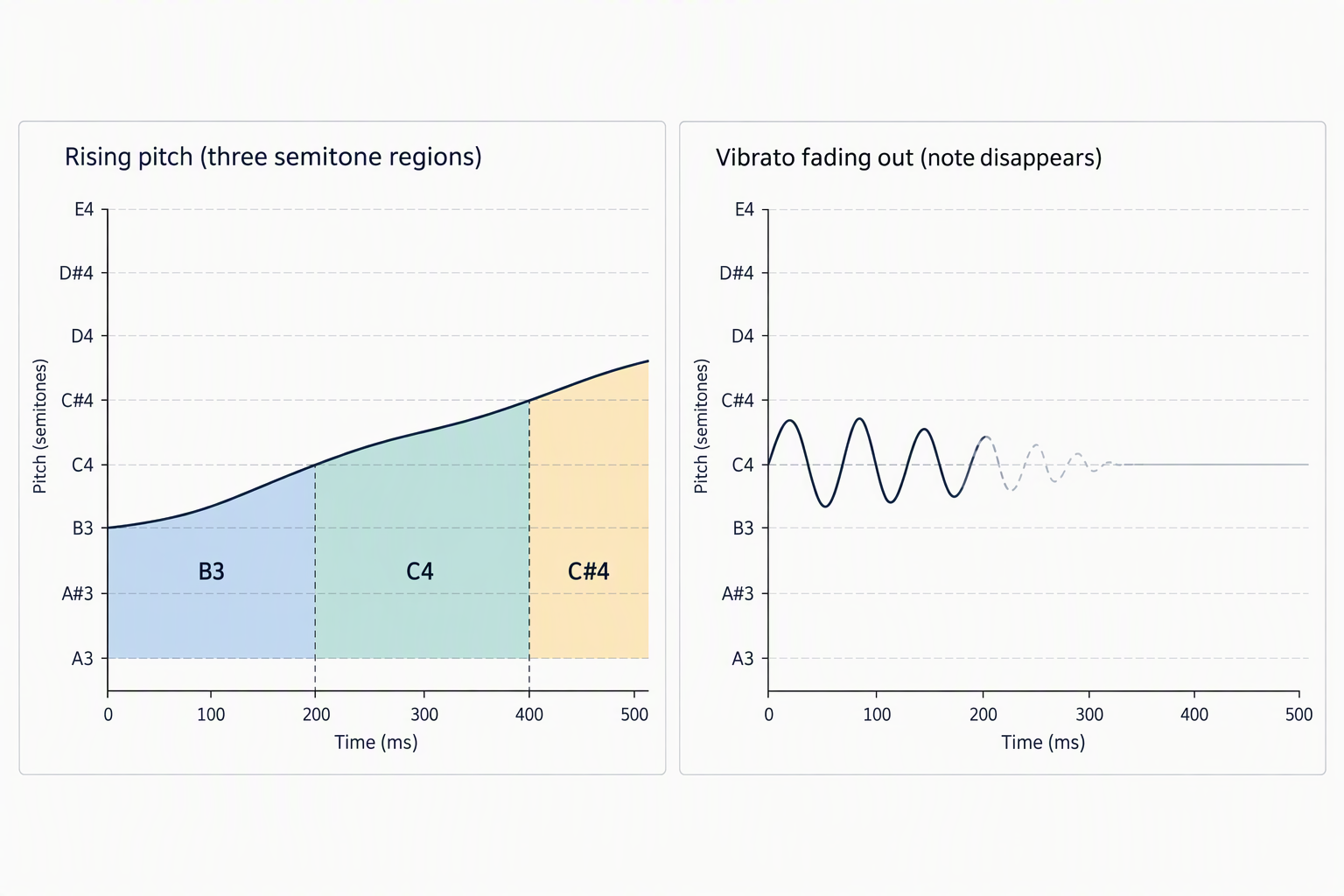
A bend does not come out as one bent note. It comes out as a stack of separate notes, one for every semitone the string passes through: bend a B3 up a whole tone on this converter and the MIDI file contains three notes — B3, then C4, then C#4. Vibrato is worse behaved. Past ±16 cents it starts chopping a single held note into pieces, and past ±58 cents the note disappears from the file altogether. Every number below was measured by running this site's own analyser (dsp.js) on synthesised guitar tones whose correct answer we knew in advance.
None of this is a bug you can argue with, and none of it is specific to our tool. A Standard MIDI file stores a note as a key number plus a start and an end. What follows is the exact arithmetic behind that, measured rather than described, plus the two controls that actually change the outcome.
Why a moving pitch gets chopped
Three facts from the source, in the order they happen:
- One pitch per frame. The analyser reads the audio in overlapping windows of 2048 samples — 92.88 ms at the 22050 Hz working rate — and advances 256 samples, or 11.610 ms, between frames. Each frame produces a single fundamental estimate, f0.
- f0 is rounded to the nearest key.
Math.round(69 + 12 * log2(f / 440)). Rounding, not truncating, so the switching point sits half a semitone above the note, not at it. - A new note starts whenever that rounded number changes. The segmenter walks the frames and opens a note each time the key number differs from the frame before it.
Put those together and a pitch that slides is cut at every semitone boundary it crosses, with a time resolution of 11.6 ms. Then the writer has no way to put the pieces back together, because the file format it writes has no bend in it:
note on  -> 0x90 key velocity
note off -> 0x80 key velocity        // that is the entire vocabulary of the note track
We checked the exported file rather than trusting the reading. The three-note result of one bent string is an 81-byte file whose note track contains only note-on and note-off events. There is no pitch-bend event in it, and the single 0xE0 byte you can find in the hex dump belongs to the header field that says 480 ticks per quarter note (0x01E0), not to a bend message.
index,midi_note,note_name,start_sec,end_sec,duration_sec,velocity
1,59,B3,0.1858,0.7198,0.5341,117
2,60,C4,0.7314,0.8824,0.1509,115
3,61,C#4,0.8824,1.3351,0.4528,113
That is one note played on one string: held half a second, bent up a whole tone over 300 ms, held again. It is three rows in the CSV and three note pairs in the MIDI file.
Measured: how far you bend against how many notes you get
| Bend (semitones) | Notes out | What came out |
|---|---|---|
| 0.25 | 1 | B3 |
| 0.50 | 1 | B3 |
| 0.75 | 2 | B3 → C4 |
| 1.00 | 2 | B3 → C4 |
| 1.50 | 2 | B3 → C4 |
| 2.00 | 3 | B3 → C4 → C#4 |
| 3.00 | 4 | B3 → C4 → C#4 → D4 |
| 4.00 | 5 | B3 → C4 → C#4 → D4 → D#4 |
| 5.00 | 3 | B3 → C4 → E4 |
Up to four semitones the rule is clean: the number of notes is the number of semitones you crossed, plus one. Stay under half a semitone and nothing splits, because the rounding never tips over.
The last row is the interesting failure. At five semitones in 300 ms, each semitone band lasts only about 60 ms, and the default shortest-note setting of 60 ms starts deleting the middle pieces. The bend did not come out as six notes; it came out as three, with two of them missing. That is the 60 ms floor, not a different rule.
Measured: bend speed decides the size of the pieces, not their number
| Bend time (ms) | Bend rate (sem/s) | Notes | Pieces |
|---|---|---|---|
| 50 | 40.0 | 2 | B3 476 ms | C#4 360 ms |
| 80 | 25.0 | 2 | B3 476 ms | C#4 372 ms |
| 100 | 20.0 | 2 | B3 488 ms | C#4 372 ms |
| 150 | 13.3 | 3 | B3 499 ms | C4 81 ms | C#4 406 ms |
| 200 | 10.0 | 3 | B3 511 ms | C4 104 ms | C#4 418 ms |
| 300 | 6.7 | 3 | B3 534 ms | C4 151 ms | C#4 453 ms |
| 400 | 5.0 | 3 | B3 569 ms | C4 209 ms | C#4 464 ms |
| 600 | 3.3 | 3 | B3 627 ms | C4 302 ms | C#4 522 ms |
| 900 | 2.2 | 3 | B3 697 ms | C4 453 ms | C#4 592 ms |
Two things fall out of this. First, speed does not change the count, it changes the lengths. Bend slower than about 100 ms and the middle note becomes long enough to survive the 60 ms floor; bend faster and it is too short to be written at all, which is why the fast rows show two notes instead of three.
Second, the middle piece is reliably about half the bend time — 81 ms of a 150 ms bend, 151 ms of 300 ms, 302 ms of 600 ms, 453 ms of 900 ms. That is exactly what you would predict from rounding: out of a two-semitone bend, the pitch spends one semitone inside the C4 band and one semitone inside the bands on either side.
We repeated the same 300 ms bend on four different strings. Low E at fret 3, A at fret 5 and G at fret 7 all produced three pieces, with the middle one at 151, 151 and 128 ms. The high E at fret 12 produced two, with the middle piece dropped — the same 60 ms floor acting on a slightly shorter middle band.
Slides: fast gives you two notes, slow gives you the whole fretboard
| Slide time (ms) | Rate (sem/s) | Notes | What came out (lengths in ms) |
|---|---|---|---|
| 100 | 70.0 | 2 | A2 267 | E3 279 |
| 150 | 46.7 | 2 | A2 279 | E3 279 |
| 200 | 35.0 | 2 | A2 279 | E3 279 |
| 300 | 23.3 | 2 | A2 290 | E3 302 |
| 450 | 15.6 | 8 | A2 302 | A#2 58, B2 58, C3 58, C#3 58, D3 70, D#3 70 | E3 302 |
| 600 | 11.7 | 8 | A2 313 | six pieces of 81–93 | E3 313 |
| 900 | 7.8 | 8 | A2 337 | six pieces of 128–139 | E3 337 |
| 1400 | 5.0 | 8 | A2 372 | six pieces of 186–209 | E3 383 |
The same 60 ms floor governs everything here. Slide in under about 300 ms and every intermediate semitone is too short to be written, so you get a clean two-note result: where you started and where you landed. That is usually what you wanted. Slide slowly and you get the full chromatic run — eight notes for seven semitones — which is rarely what you wanted but is at least honest about what happened.
Vibrato: where a note stops splitting and starts disappearing
Vibrato is the case where the failure stops being cosmetic. Each frame also gets a harmonic-comb score, sal — how well the spectrum lines up on a harmonic series. A pitch that is moving inside the 92.88 ms window smears its own harmonics, and the score falls. The threshold it has to clear is set by the sensitivity slider:
salThr = 0.35 - 0.25 * (sensitivity / 100) // 0.20 at the default sensitivity of 60| Vibrato depth | Notes out | Lowest score | Result |
|---|---|---|---|
| ±5 cents | 1 | 0.274 | one clean note, 1149 ms |
| ±10 | 1 | 0.244 | one clean note |
| ±15 | 1 | 0.216 | one clean note |
| ±16 | 1 | — | still one note |
| ±18 | 3 | — | splitting starts here |
| ±20 | 7 | 0.193 | pieces of 104–174 ms |
| ±30 | 9 | 0.174 | pieces of 93–104 ms |
| ±40 | 6 | 0.165 | pieces of 128–139 ms |
| ±50 | 6 | 0.150 | pieces of 128–139 ms |
| ±60 | 0 | 0.136 | the note is gone |
| ±70 | 0 | 0.124 | gone |
| ±80 | 0 | 0.116 | gone |
The cause is visible in the score column: it falls in step with the depth — 0.274 at ±5 cents down to 0.136 at ±60 — and it crosses the 0.20 threshold somewhere between ±50 and ±60. Below the threshold, no frame in the note qualifies, so no note is written at all. Not a quiet note, not a short note: nothing. If a sustained note with heavy vibrato is missing from your MIDI while the rest of the take converted fine, that is the mechanism.
Raising sensitivity does bring it back, but not usefully. At sensitivity 70 the lost ±60-cent note returns as four pieces of 58 ms; at 80 and above, as eight pieces of 58 ms. You have traded a missing note for a shredded one.
The two controls that actually help
Shortest note length is the one that works. Because the middle piece of a bend is about half the bend time, setting the shortest note just above that deletes the middle and leaves you with the two notes you meant to play. Measured, on the whole-tone bend:
| Bend time (ms) | Middle piece (ms) | Setting that removes it |
|---|---|---|
| 150 | 81 | 90 ms |
| 200 | 104 | 120 ms |
| 300 | 151 | 160 ms |
| 400 | 209 | 220 ms |
| 600 | 302 | 310 ms |
| 900 | 453 | 460 ms |
Read it as a rule of thumb: set the shortest note to a bit more than half the time you take to bend. A 200 ms bend wants 120 ms. The cost is real — genuine short notes under that length are deleted too — so check the piano roll after you change it.
Sensitivity is the one that does not. We swept it on the same 200 ms bend: at 0 and 10 the whole note disappeared; at 20 and 30 it came back as a single B3 of 453–464 ms, meaning the note you bent to was gone; from 40 upward it was the usual three pieces. Turning sensitivity down does not merge a bend, it deletes the landing note. Quantising does not merge it either — it moves the three pieces onto the beat grid and leaves three pieces.
The rest of the guitar fits comfortably
None of the above is a range problem. The pitch search runs from 55 Hz to 1800 Hz, and every note a guitar produces sits inside that, including the extremes:
| Note | True (Hz) | Read (Hz) | MIDI out | Semitone in bins |
|---|---|---|---|---|
| E2, low string open | 82.41 | 82.37 | 40 — E2 | 0.455 |
| A2 | 110.00 | 109.99 | 45 — A2 | 0.608 |
| D3 | 146.83 | 146.80 | 50 — D3 | 0.811 |
| G3 | 196.00 | 195.99 | 55 — G3 | 1.082 |
| B3 | 246.94 | 247.07 | 59 — B3 | 1.364 |
| E4, high string open | 329.63 | 329.60 | 64 — E4 | 1.821 |
| E6, 24th fret | 1318.51 | 1318.51 | 88 — E6 | 7.282 |
| D2, drop D | 73.42 | 73.42 | 38 — D2 | 0.405 |
| B1, 7-string low B | 61.74 | 61.69 | 35 — B1 | 0.341 |
Every one was identified correctly, and the pitch readings are within a few hundredths of a semitone. Note the low end: at the open low E a whole semitone is less than half an FFT bin wide, so the detector is interpolating rather than reading a clean peak. That is where bends and intonation drift hurt most, and it is another reason the low strings are the ones that come out chopped.
In one minute: what a bend actually looks like
The animation is a one-minute summary of the mechanism above: a rising pitch crossing semitone lines, and a vibrato that loses its note when the score threshold is crossed.
How to check your own take in four steps
- Convert the file and export the note list as CSV. The columns are
index, midi_note, note_name, start_sec, end_sec, duration_sec, velocity. - Sort by
start_secand look for runs of consecutive notes that are one semitone apart with no gap between them — one ending exactly where the next begins. That pattern is a bend or a slide, not a phrase. - Count them. If a solo you played as 40 notes comes out as 70, the difference is almost all bends and vibrato, and the shortest-note setting is the fastest way to collapse them.
- If a held note is missing entirely, look at the depth of its vibrato before you blame the threshold. Deep vibrato is the one failure here that removes a note rather than splitting it.
One honest limitation: everything above was measured on synthesised plucked-string tones — ten harmonics, exponential decay, known pitch tracks — not on a miked cabinet. Real amplifiers add compression and noise that will move these numbers, and we have not measured that. What will not change is the mechanism: rounding to a key number per frame, a new note at every semitone boundary, and a 60 ms floor underneath it all.
Questions people actually ask
Can a MIDI file store a bend at all?
Yes, in general — the format has pitch-bend messages, and that is how a real bend is normally represented. This converter does not write them. Its writer emits only note-on and note-off events, which we confirmed by reading the exported bytes rather than the code that produced them: the 81-byte file for one bent note contains no bend message. So the only shape a bend can take here is a staircase of separate semitones, and the only question is how many steps. For a converter that does preserve bends as real pitch-bend events — and what that changes in your score — see what pitch bend detection adds to audio to MIDI.
Why does my solo come out with far more notes than I played?
Nearly always bends, slides and vibrato. One whole-tone bend becomes three notes; a slow seven-semitone slide becomes eight; moderate vibrato chops a single held note into six to nine pieces, each around 100–140 ms. Raise the shortest-note setting to just above half your typical bend time and the staircase collapses back toward what you played.
Why did one sustained note vanish from the MIDI entirely?
If it had wide vibrato, that is the most likely cause. The harmonic-comb score has to clear 0.20 at the default sensitivity, and we measured it falling to 0.136 at ±60 cents of vibrato depth, at which point no frame in the note qualifies and nothing is written. Raising sensitivity brings the note back as a row of 58 ms fragments rather than as one note, so the practical fix is to convert a cleaner take or a take with less vibrato.
Can I pull the lead guitar out of a track with several guitar layers on it?
This is a question people ask out loud on production forums, usually in frustration, and the honest answer is that this tool does not separate instruments. Polyphonic mode looks for up to six pitches in each frame, but it has no idea which string or which player any of them belongs to, and two guitars playing in octaves will be treated as one pitch plus its harmonic. The full measurement of what polyphonic mode returns is in how many notes a converter can hold at once.
Related guides
- Where the note boundaries land — the frame grid and the beat grid, measured.
- How many notes a converter can hold at once — the polyphony ceiling and the harmonic rule.
- How loud a note has to be before it hits velocity 127 — the velocity arithmetic, measured.
- What is actually inside a MIDI file — the bytes, offset by offset.
- Voice to MIDI: what a single-line converter can follow — pitch range and portamento from the other direction.
- Piano to MIDI: where the keyboard falls outside the detector — the floor, the ceiling and the timbre gate, measured on the same analyser.
- Vocal to MIDI — Why a sung note comes back an octave up
- Humming to MIDI — What wordless vocals come back as
- Microphone to MIDI — What this converter does with a recording
Every number on this page can be reproduced on your own machine: convert a file, export the CSV, and read the note column against the tables above.